
This is the index's biggest single-day fall in almost a month

Sensex sinks into red at close on growth concerns.
Many analysts over the past week have said the RBI has legroom to cut rates to the tune of 65 bps by June and some like Barclays and BofA have also spoken about the likelihood of an inter-meeting cut.
.jpg)
The subdued labour market is likely to recover.

The market direction will be guided by corporate earnings, especially the oil & gas companies, since they were responsible for earnings disappointment in the past quarter as well.

India's GDP may turn positive at 1.3 per cent in the third quarter of 2020-21, having witnessed contraction in the previous two quarters due to the coronavirus pandemic, as the number of cases is falling and public spending has started rising, according to a report. The government will release the GDP numbers for the October-December quarter of the current fiscal on Friday. Projecting that the gross domestic product (GDP) may have returned to the black in the last quarter of the calendar year 2020, DBS Bank in the report said the full-year growth in real terms may be at a negative 6.8 per cent.

ICICI Bank and SBI were among the top Sensex gainers along with FMCG majors ITC and HUL.

Monetary policy stance to depend on inflation data

The index went below the crucial 50 mark.

India Inc is borrowing from global firms as interest rates sky rocket in India.

The HSBC India Composite Output Index, which maps both services and manufacturing, increased from 48.9 in March to 49.5 in April, but remained below the crucial 50 mark which indicates contraction for the second successive month.

Strong new business growth was the primary factor.
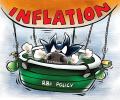
The Reserve Bank of India on Friday raised the retail inflation forecast for 2021-22 to 5.7 per cent due to supply side constraints, high crude oil and raw materials cost. The RBI in June had pegged the retail inflation estimate at 5.1 per cent for the current financial year. The RBI has the mandate to keep inflation in a band of 2-4 per cent, with a tolerance level of 2 per cent on either side.

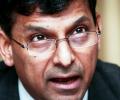
After two surprising, successive rate cuts in January and February 2015, RBI governor Raghuram Rajan decided not to reduce them further in his first policy announcement in the new financial year. Is he playing spoilsport for consumers of homes and cars?

Citing the massive surge in Omicron infections and the resultant impact on overall economic activities in the March quarter, Swiss brokerage UBS Securities has revised downwards its India's growth forecast for the current financial year to 9.1 per cent from 9.5 per cent earlier. However, UBS Securities does not see the third wave impact extending to the next financial year as it has revised upwards its real GDP forecast to 8.2 per cent, up from 7.7 per cent earlier, expecting the real GDP growth to remain well above the historical average. The World Bank pegs it at 8.3 per cent, unchanged from its June assessment, saying the recovery is not broad-based yet.

In fuel and power segment, inflation saw a sharp surge to a near double digit inflation at 9.99 per cent, against 4.37 per cent in July.

A combination of farm loan debt waivers by state governments and the implementation of the pay commission award could entail some fiscal slippages and pose a risk to inflation

There is little scope for significant monetary easing even in the next fiscal year.
.jpg)
The year-end should not be a time for any spectacular changes in the banking system and must pass smoothly, Rajan told reporters after announcing the bi-monthly monetary policy, which left key policy rates unchanged.

GST rate cut for real-estate, income transfer scheme, farm loan waivers execution and recapitalisation of PSU banks have the potential to boost India's growth in a few months, says Neelkanth Mishra.

Shaktikanta Das is a master of the finest balancing act who listens to all but takes his own decisions, discovers Tamal Bandyopadhyay.

The Reserve Bank of India has raised inflation projection to 6.5 per cent with an upside bias by this fiscal end from 5 per cent projected earlier.

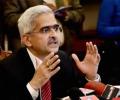
Here are the highlights of the monetary policy announced by RBI governor Shaktikanta Das on Friday.
The Reserve Bank of India on Friday raised the retail inflation target for the current financial year to 5.7 per cent on the back of rising global prices amidst the ongoing geo-political tensions, even as it expected the prices of cereals and pulses to soften on prospects of good winter crop harvest. "Global food prices along with metal prices have hardened significantly. "Economy is grappling with a sharp rise in inflation... Inflation is now projected at 5.7 per cent in 2022-23 with Q1 at 6.3 per cent; Q2 at 5 per cent; Q3 at 5.4 per cent and Q4 at 5.1 per cent," RBI Governor Shaktikanta Das said while unveiling the first monetary policy review for the current fiscal year.

The 30-share Sensex jumped 729 points to end at 28,076 and the 50-share Nifty soared 217 points to end at 8,494.

Firms hired additional hands to keep up with the production demand

RBI's status quo on rates disappoints economists.

The cutback on export credit refinance facility is another step towards a shift away from sector-specific liquidity allocations.

No stock on BSE Sensex ended in red while only 3 stocks in the broader Nifty50 index settled the day negative

Consumer prices were forecast to have risen 10.00 per cent annually last month, barely changed from the 10.09 per cent clocked in October.

In the Monetary Policy Review on Tuesday, RBI raised the repo, the rate at which it lends to banks, by 0.25 per cent to 7.25 per cent while keeping reverse repo, the rate at which it borrows from banks unchanged at 6 per cent.

The RBI, however, kept other key rates and ratios like repo, reverse repo and cash reserve ratio unchanged.

New Reserve Bank of India chief makes his first monetary policy statement on Friday with expectations he may scale back some of the emergency measures that have helped the rupee bounce from a record low.
The central bank kept cash reserve ratio unchanged at 4 per cent.

The RBI has hiked repo or short-term lending rate up by 0.25 pc to 7.75 pc.
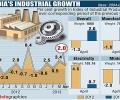
Vivek Mahajan (Head - Research) Aditya Birla Money, analysed the slow IIP growth.

The poll of over 30 economists, taken in the past week, showed Asia's third largest economy will expand 7.8 percent in the fiscal year ending March 2017.

Retail inflation slowed to 4.29 per cent in April from 5.52 per cent in March, mainly due to easing food prices, government data showed on Wednesday. The Reserve Bank mainly factors in the retail inflation based on Consumer Price Index (CPI) while arriving at its monetary policy. As per the data released by Ministry of Statistics and Programme Implementation, inflation in the food basket was 2.02 per cent in April, down from 4.87 per cent in the preceding month.

It pointed out that farm loan waivers, combined with a potential stimulus which the government is mulling now, can result in a 1 percentage point slippage in fiscal deficit

The Reserve Bank's growth projection for next financial year is lower than 8-8.5 per cent projected by the finance ministry in the recent Economic Survey which was tabled in Parliament on January 31. Unveiling the bi-monthly policy, RBI governor Shaktikanta Das said, "Recovery in domestic economic activity is yet to be broad-based, as private consumption and contact-intensive services remain below pre-pandemic levels."
